Home
- Details
- Written by: po3dno
- Category: Power Shell
- Hits: 1363
If an attack made it into your active directory environment and got a golden ticket, there is a specific set of steps you need to take to make sure you've cleaned out the adversary:
- Disconnect the affected networks. Entirely.
- Remediate any persistence mechanisms left behind
- Reset passwords of ALL high privileged access accounts
- Reset passwords of all VPN access credentials (+other remote access you may have)
- Change the krbtgt hash using https://gallery.technet.microsoft.com/Reset-the-krbtgt-account-581a9e51 run in it the order of using first option 1, then option 2 and then option 3: (https://cdn-images-1.medium.com/max/1000/1*Gk48jksjPuThTrPnJNHW-w.png)
- Wait minimum 10 hours
- Change the krbtgt hash again using https://gallery.technet.microsoft.com/Reset-the-krbtgt-account-581a9e51 run in it the order of using first option 1, then option 2 and then option 3: (https://cdn-images-1.medium.com/max/1000/1*Gk48jksjPuThTrPnJNHW-w.png)
- Details
- Written by: po3dno
- Category: Other
- Hits: 1254
If you copy the “MASTER .VHDX”, you could re-use it for multiple boots, even for other machines.
Here’s the procedure once you have an existing MASTER .VHDX already created.
First, copy and rename the .VHDX to a different name depending on what you will install, like “Windows_10_for_Testing_Betas.VHDX” or whatever. In my screenshots I’m still using a similar name than before, though.
1. Check initial boot loaders
You can configure the boot options of windows by using the command-line tool bcdedit.exe.
bcdedit /v
Let’s say you start in another computer with a single boot from a single regular partition, you’ll see a similar description to the following:
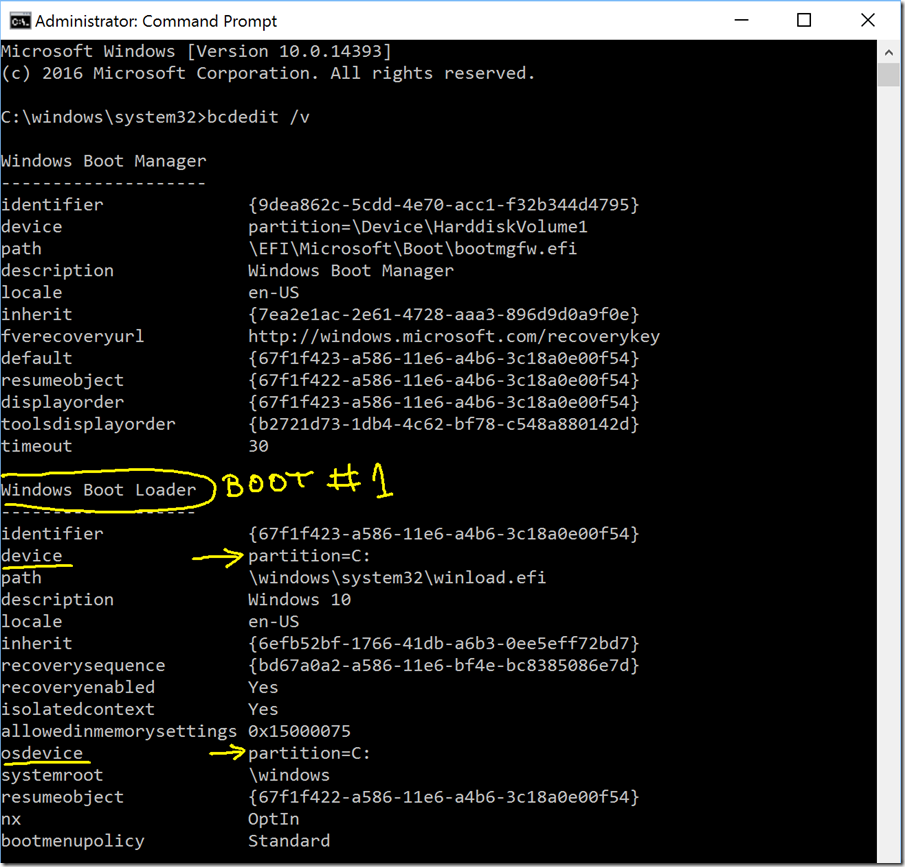
You can see that I currently just have a single boot loader, booting from the C: partition.
2 What we want to do is to create a second BOOT LOADER by copying the current Windows Boot Loader. Type:
bcdedit /copy {current} /d “Windows 10 .VHDX Boot”
That line means you are copying the current Boot loader (the one I marked) but naming it with a different DESCRIPTION. And also, very important, when you copy any BOOT LOADER, the new copy will have a new GUID identifier, which is what you are going to use.
Then, type again bcdedit /v to see the new BOOT LOADER created:
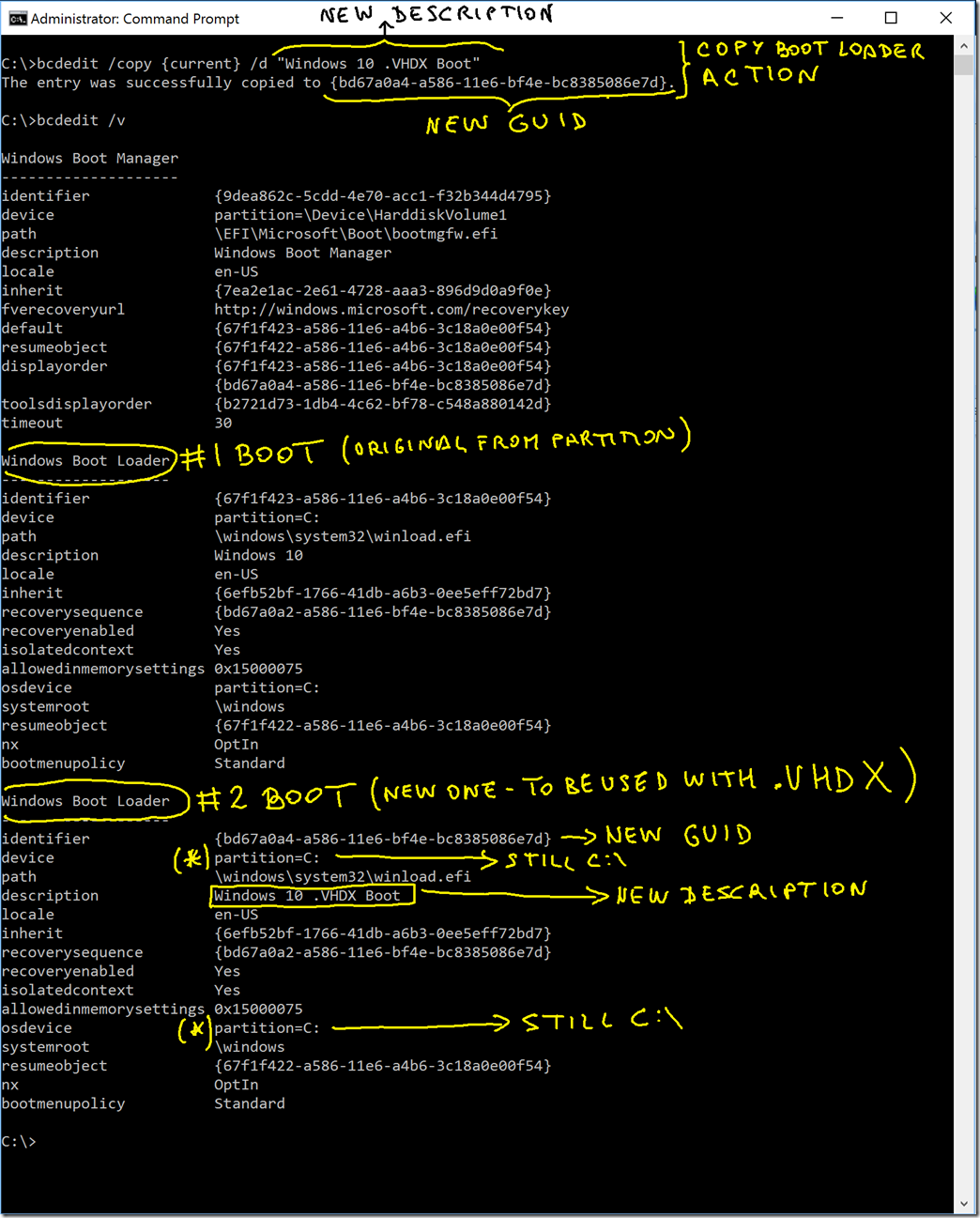
You can see how now you have a second BOOT LOADER (#2 BOOT) with a different GUID than the original (#1 BOOT).
It also has the new description applied like “Windows 10 .VHDX Boot”. You’ll see that description when selecting the Boot option when starting your machine.
However ,you are still not done, as that second BOOT LOADER is still pointing to the C:\ partition, and you want it to be pointing to the .VHDX file!
3 Copy the new GUID (from BOOT #2) with the mouse, so you can use it in the next step. In this case I copy: {bd67a0a4-a586-11e6-bf4e-bc8385086e7d}
4 In order to point BOOT LOADER #2 to your .VHDX file, type the following 2 commands:
bcdedit /set {My_new_GUID_Number} device vhd=[C:]\VHDs\Windows10_Enterprise_x64_Bootable.vhdx
bcdedit /set {My_new_GUID_Number} osdevice vhd=[C:]\VHDs\Windows10_Enterprise_x64_Bootable.vhdx
Note the difference in “device” and “osdevice”..
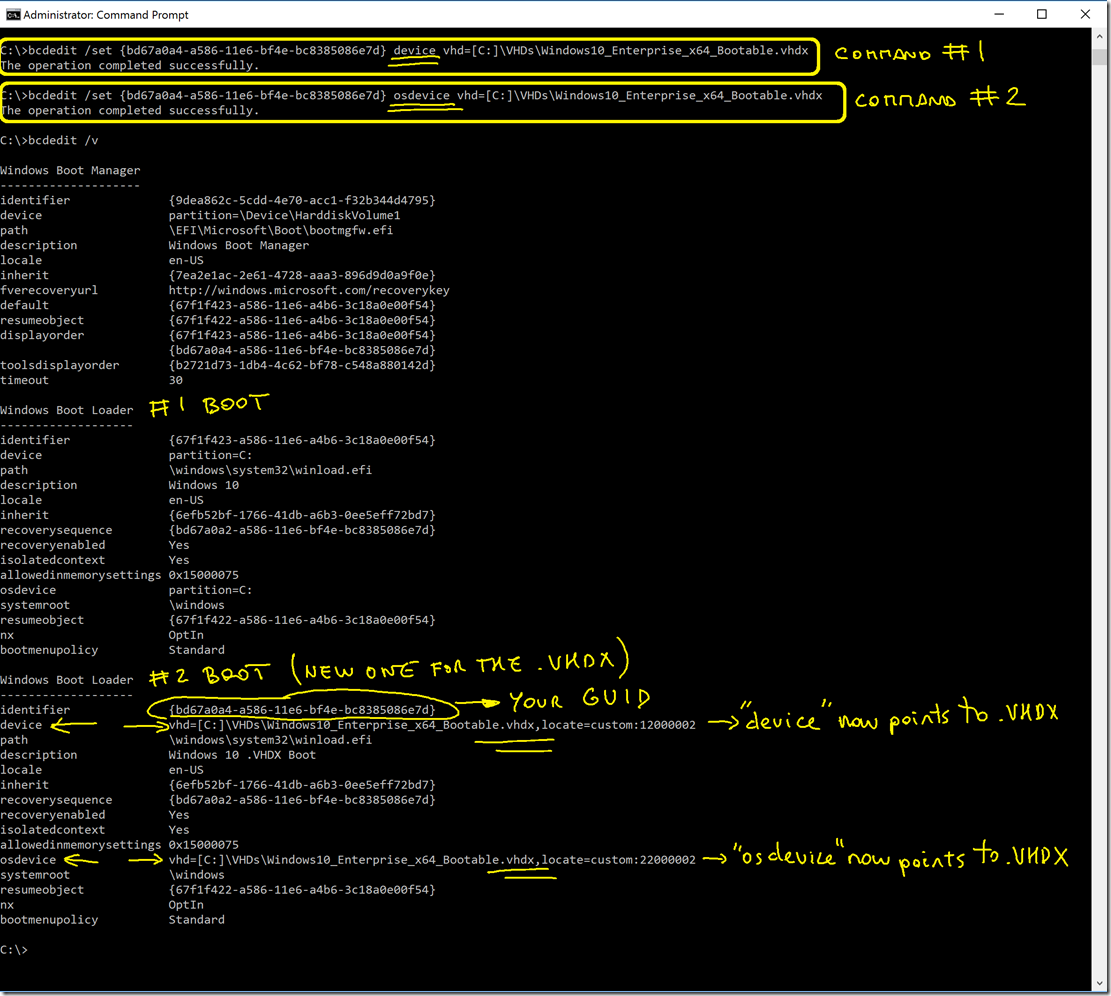
Now, you are done with the “hard” configuration.
Check that you have this new boot from Computer properties –> Advanced System Settings –> Advaced –>Startup and Recvovery –>Settings button:
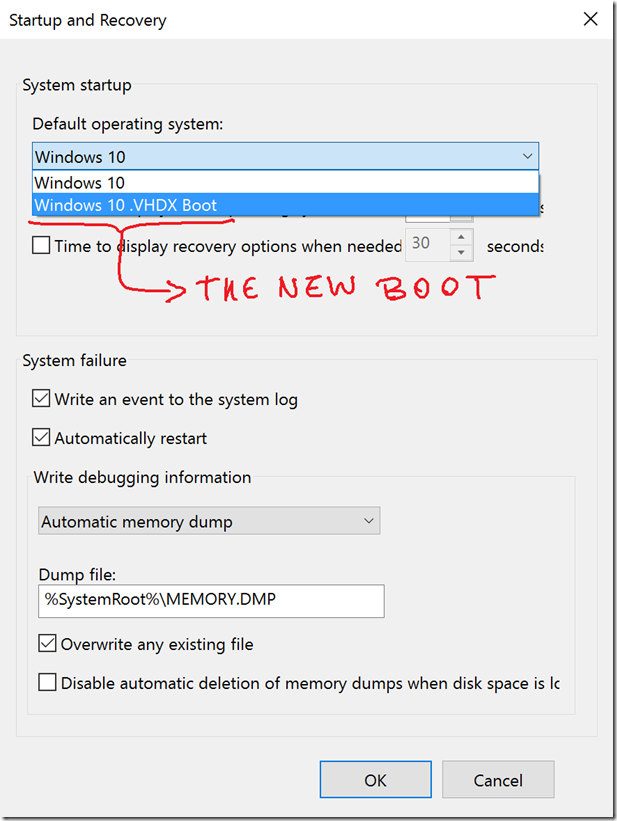
You can just reboot the machine and select the BOOT option for your new .VHDX, and it’ll boot natively from that .VHDX!
Other BCDEDIT configurations:
You can update your boot loaders with commands like the following using the GUID of the BOOT LOADER you want to change:
TO CHANGE THE DESCRIPTION
bcdedit /set {xxxxxxxx-xxxx-xxxx-xxxx-xxxxxxxxxxxx} description “Windows 7 .VHD Image”
COPY
bcdedit /copy {Original_GUID_Number} /d “my new description”
or
bcdedit /copy {current} /d “my new description”
or
bcdedit /copy {default} /d “my new description”
- Details
- Written by: po3dno
- Category: MSSQL
- Hits: 1195
DECLARE @name VARCHAR(50) -- database name
DECLARE @path VARCHAR(256) -- path for backup files
DECLARE @fileName VARCHAR(256) -- filename for backup
DECLARE @fileDate VARCHAR(20) -- used for file name
-- specify database backup directory
SET @path = 'D:\Backup\'
-- specify filename format
SELECT @fileDate = CONVERT(VARCHAR(20),GETDATE(),112)
DECLARE db_cursor CURSOR READ_ONLY FOR
SELECT name
FROM master.sys.databases
WHERE name NOT IN ('master','model','msdb','tempdb') -- exclude these databases
AND state = 0 -- database is online
AND is_in_standby = 0 -- database is not read only for log shipping
AND replica_id is NULL --without replica
OPEN db_cursor
FETCH NEXT FROM db_cursor INTO @name
WHILE @@FETCH_STATUS = 0
BEGIN
SET @fileName = @path + @name + '_' + @fileDate + '.BAK'
BACKUP DATABASE @name TO DISK = @fileName
FETCH NEXT FROM db_cursor INTO @name
END
CLOSE db_cursor
DEALLOCATE db_cursor
- Details
- Written by: po3dno
- Category: MSSQL
- Hits: 1200
- Details
- Written by: po3dno
- Category: Other
- Hits: 1071
Архивы
Создать архив .tar/.tar.gz
tar -cvf file.tar /full/path — создать .tar (без сжатия)
tar -czvf file.tar.gz /full/path — создать .tar.gz (архив GZip)
Распаковать архив .tar/.tar.gz
tar -xvf file.tar — распаковать обычный .tar (без сжатия)
tar -xzvf file.tar.gz — распаковать .tar.gz (запакованны GZip-ом)
Распаковать архив .gz (GZip, без TAR)
gunzip file.gz — распаковать обычный .gz (GZip, без TAR. Распаковываемый архив должен иметь права на исполнение: chmod +x file.gz)
Базы данных MySQL
Импорт дампа базы данных
mysql -u db_user -p -h localhost db_name < dump.sql
Импорт дампа базы данных, упакованных в gzip (*.sql.gz)
gunzip < dump.sql.gz | mysql -u db_user -p db_name
Экспорт базы данных (создание дампа)
mysqldump -u db_user -p -h localhost db_name > dump.sql
Создание архива GZip с дампом БД
mysqldump -u db_user -p -h localhost db_name | gzip > dump.tar.gz
Создание дампа нескольких баз данных одновременно
mysqldump -u db_user -p -h localhost -B db_name1 db_name2 db_name3 > databases.sql
Создание дампа всех баз данных
mysqldump -u db_user -p -h localhost -A > all-databases.sql
Сохранить только структуру БД
mysqldump —no-data -u db_user -p -h localhost db_name > schema.sql
Создание дампа только одной или нескольких таблиц БД
mysqldump -u db_user -p -h localhost db_name tbl_name1 tbl_name2 tbl_name3 > dump.sql
Дополнительные атрибуты (уменьшают размер дампа и повышают скорость работы)
mysqldump -Q -c -e -u db_user -p -h localhost db_name > /path/to/file/dump.sql
— Q — оборачивает имена обратными кавычками;
— c — делает полную вставку, включая имена колонок;
— e — делает расширенную вставку.
Если не запускается MySQL, лог ошибок можно увидеть прямо в консоли (команда для Windows)
mysqld —defaults-file=C:Program Files…my.ini —console
Файлы/директории
Узнать абсолютный путь до текущего каталога
pwd
Удалить папку со всем ее содержимым
rm -R /path/to/dir
Создать символьную ссылку
ln -s /etc/apache2/sites-available/site.com.conf /etc/apache2/sites-enabled/site.com.conf
Подсчитать количество файлов в текущем каталоге (включая вложенные)
find . -type f | wc -l
Подсчитать занимаемый размер каталога
du -sh /var
Вывести на экран количество файлов в поддиректориях текущего каталога
for D in `ls -Fl | grep / | awk ‘{print $9}’` ; do echo $D `find -L $D -type f -print | wc -l` ; done
Удалить в директории все файлы старше N дней
find /home/user -type f -mtime +N -exec rm {} ;
Узнать информацию об использовании inodes (файловых дескрипторов):
df -i
Создать патч
diff -uN file.orig file.new > file.patch
Наложить патч
patch file.orig < file.patch
Найти определенные файлы и скопировать их с сохранением иерархии
find . -name «ru.po» -exec cp —parents «{}» /destination/dir/ «;»
Прочее
Вывести последние 10 строк из лог-файла, с автообновлением в реальном времени
tail -n10 -f /var/log/sites/your-site.ru.error.log
(путь до файлов с логами Apache у вас скорее всего будет другим)
Узнать информацию о процессоре
cat /proc/cpuinfo
или
lscpu
Показать ТОП10 медленных запросов MySQL (сортировка по времени исполнения time):
mysqldumpslow -s t -t 10 /var/log/mysql-slow.log
Показать ТОП10 запросов MySQL, в который не используются индексы (сортировка по кол-ву вызовов count):
mysqldumpslow -s c -t 10 /var/log/mysql-slow.log
Установить корректно конвертер шрифтов (Debian):
apt-get install libssl-dev build-essential zlibc zlib-bin libidn11-dev libidn11
wget http://people.mozilla.com/~jkew/woff/woff-code-latest.zip
unzip woff-code-latest.zip -d sfnt2woff && cd sfnt2woff && make && mv sfnt2woff /usr/local/bin/